Understanding the Inside Motherboard
The motherboard or mainboard is also commonly called a main board where there are components and chip controller responsible for managing data traffic in the system motherboard. Common functions of the motherboard is a pair processor, RAM, VGA Card, Sound Card, Internal Modem, and others.
Based on the use of the processor, motherboard (mobo) is divided into three parts, namely:
- For Dual Processor
- For Intel Processor
- For AMD Processor
A motherboard there are several components such as:
- Processor socket
- chipset
- Bus Controller
- Memory slot
- Expansion slot
- Port Drive
- BIOS
- ROM
- Power Connector
Chart a Motherboard:
 |
| motherboard |
Form Factor Motherboard
The motherboard has a characteristic and different sizes, which we commonly refer to the form factor.
 |
| Form Factor Comparison |
The figure shows that the mobo has a different size.
Here is a comparison table of various kinds of form factors from Mobo:
Name PCB size (mm)WTX 356 × 425AT 350 × 305Baby- AT 330 × 216BTX 325 × 266ATX 305 × 244EATX (Extended) 305 × 330LPX 330 × 229microBTX 264 × 267NLX 254 × 228Ultra ATX 244 ×?microATX 244 × 244DTX 44 × 203FlexATX 229 × 191Mini-DTX 203 × 170EBX 203 × 146microATX 171 × 171Mini-ITX 170 × 170EPIC (Express) 165 × 115ESM 149 × 71Nano-ITX 120 × 120COM Express 125 × 95ESMexpress 125 × 95ETX / XTX 114 × 95Pico-ITX 100 × 72PC / 10 (-plus) 96 × 90ESMini 95 × 55Beagle Board 76 × 76Mobile-ITX 60 × 60CoreExpress 58 × 65
 Motherboards Pictured above is the form factors to the difference of the various dimensions of the size of the motherboard.
 |
| Formfactors |
Specifications Motherboard:
In the selection of the motherboard, of course, we must consider several things. This will determine the specifications of the computers we use, namely:
- Processor support is used, use a slot or socket.
- Internal Speed Cache Memory, like 512 Kb, 1 Mb, 2 Mb, etc. The larger capacity also tightened the process.
- Upgrading can be done, be it to the processor, amount of RAM, etc.
- The number of slots available, Memory Slot, Expansion Slots: ISA, PCI, AGP or PCI Express.
- What supports VGA Card, Audio Card, LAN Card Onboard?
- Support The motherboard settings via jumper or BIOS.
Modem is short for modulator and demodulator. The modulator serves to make the process of laying the data on the signal information into the carrier signal to be sent to the user through a particular medium, this process is commonly referred to as the modulation process. in this process the data from the computer in the form of a digital signal is converted into an analog signal. While demodulator functions as a process of getting back the data sent by the sender. In this process the data will be separated from the high-frequency data in the form of an analog signal is converted back into a digital signal that can be read by the computer. So the conclusion is a function of the modem hardware for two-way communication function that converts digital signals into analog signals and vice versa for sending messages / data to the addressee. It could also be interpreted as an intermediary to connect your computer to the Internet network.
Many types - the type of modem that existed at this time, the modem can be distinguished based on the type of installation and network. if based on modem installation can be divided into an internal modem and an external modem while the modem based network can be divided into the cable modem with the media and meodem with wireless media.
- Internal modem is a card attached to the motherboard slot. advantage of this modem is way easy installation and the price is relatively cheaper.
- External modem is a modem that is installed outside the computer, usually plugged into the USB slot.
- Cable modem that uses media that sebuahmodem wired as a media intermediary (eg, cable TV and telephone network)
- Without a cable modem, this modem uses wireless media to the intermediary (eg, a GSM modem, Modem CDMA and others)
Cell phone or mobile phone today has mushroomed as with a laptop or computer. Neither of elementary school children to grandparents now use mobile phones to communicate. But if anyone knows who the inventor of the cell phone or the mobile phone itself ?? Sharing this time I will discuss about the history of mobile phones or mobile phones.
Definition
Cell phone or mobile phone or cell phone is an electronic telecommunications device that has the same basic capabilities with conventional fixed-line telephone, but can be taken anywhere (portable, mobile) and does not need to be connected to the network using a wired telephone (Wireless; LAN). Indonesia currently has two mobile phone network is the GSM system (Global System for Mobile Telecommunications) and system of CDMA (Code Division Multiple Access). Governing bodies of Indonesian cellular telecommunications is Indonesian Cellular Telecommunications Association (ATSI).
History
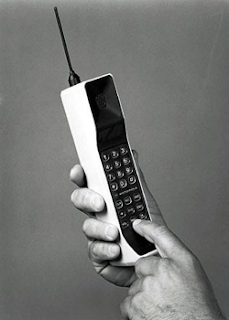
According to wiki aunt Indonesia inventor of the first mobile phone system is Martin Cooper, a Motorola factory workers on April 3, 1973, though often touted inventor of the mobile phone is a team from one division of Motorola (a division of Cooper's work) with the first model is DynaTAC. The idea proposed by Cooper is a communication tool that is small and easy to carry travel flexibly.
Cooper and his team face the challenge of how to include all electronic material into small-sized tool for the first time. Finally a first mobile phone was successfully completed with a total weight of weighing two kilograms. To make, manufacturer Motorola will cost approximately US $ 1 million. "In 1983, the portable cellular phone valued at US $ 4 thousand (Rp36 million), equivalent to US $ 10 thousand (Rp90 million).
After successfully producing the cell phone, the next biggest challenge is to adapt the infrastructure to support the communication system of the cell phone by creating a network system that only requires 3 MHz spectrum, the equivalent of five TV channels are channeled to the rest of the world.
Other figures are known to be very instrumental in the world of mobile communications is Amos Joel Jr. who was born in Philadelphia, March 12, 1918, he was recognized worldwide as an expert in the field of switching. He received a bachelor's degree (1940) and master's (1942) in electrical engineering from MIT. Shortly after the study, he began his career over 43 years (from July 1940-March 1983) at the Bell Telephone Laboratories, where he received more than 70 US patents in the field of telecommunications, particularly in switching. Amos E Joel Jr., making the system connector (switching) cell phone from one region to another region of the cell. Switching this should work when mobile users move or move from one cell to another so that the conversation is not interrupted. Since the discovery of this Joel Amos cell phone use be comfortable.
Development
The early generation
The history of the discovery of a cell phone can not be separated from the development of radio. Early discovery of cellular phones began in 1921 when the Detroit Michigan Police Department tried to use the phone one-way car. Then, in 1928 the Detroit Police Department began using a one-way radio communication on all patrol cars with a frequency of 2MHz.
In further developments, radio evolved into a two-way communication with the '' frequency modulated '' (FM).
In 1940, Galvin Manufactory Corporation (now Motorola) to develop portable handie-talkie SCR536, which means a communication tool on the battlefield during World War II. This period is the next generation of mobile phone 0 or 0-G, where cell phones were introduced.
After removing the SCR536, then in 1943 returned Galvin Manufactory Corporation issued a two-way radio FM partable first named SCR300 backpack model for the US Army's equipment weighs about 35 pounds and be able to work effectively within the operating range of 10 to 20 miles.
Mobile phone system 0-G still uses a VHF radio system to connect the phone directly to PSTNlandline. The weakness of this system is the problem of network congestion which then led to efforts to change the system.
Generation 0 ended with the invention of the modern concept by engineers from Bell Labs in 1947. They found the concept of using hexagonal phone as a basic cell phone. However, this new concept was developed in the 1960s.
Generation 1
The first generation of mobile phones also called 1G. 1-G is the first actual cell phone. In 1973, Martin Cooper of Motorola Corp. found a cell phone first and introduced to the public on April 3, 1973. The cell phone that was found by Cooper weighs 30 ounces or about 800 grams. This discovery has changed the world forever. The technology used is 1-G is still analog and known as AMPS. AMPS uses frequency between 894 MHz and 825 Mhz- operated at Band800 Mhz. Because it is analog, the system used is regional. One drawback generation 1-G is because the size is too big to be held by hand. The large size is due to the need of energy and poor battery performance. In addition, generation 1-G still has problems with mobility users. When placing a call, the user mobility is limited to coverage area of a mobile phone.
Generation 2
The second generation or 2-G appeared in about the 1990s. 2G in the US are already using CDMA technology, while in Europe, uses GSM technology. Uses standard GSM frequencies of 900 MHz and 1800 MHz frequencies. With these frequencies, GSM has a capacity greater customer. On the 2G generation analog signal has been replaced with a digital signal. The use of digital signal equip cell phones with voice mail, call waiting, and SMS.
Mobile phones in this generation also has a smaller size and lighter due to the use of digital chip technology. The smaller size is also due to the power requirements of smaller batteries. Advantages of generation 2G is the size and weight of the smaller and lower radio signals, thus reducing the harmful effects of radiation users.
Beneration 3
This generation is also called 3G that allows network operators to give their users a wider range, including internet video calls as well as high-tech. Within there are 3 standard for 3G telecom world ie Enhance datarates for GSM Evolution (EDGE), Wideband-CDMA and CDMA 2000 3G generation downside of this is the relatively higher costs, and the lack of network coverage because it is still new technology. But the interesting thing in this generation is to start the inclusion of the operating system on a mobile phone so as to make the phone features a full PC functionality even close. The operating system used, among others, Symbian, Android and Windows Mobile
Generation 4
This generation is also called Fourth Generation (4G). 4G is a phone system that offers a new approach and infrastructure solutions that integrate wireless technologies that already exist, including wireless broadband (WiBro), 802.16e, CDMA, wireless LAN, Bluetooth, and others. 4G systems based on the heterogeneity of IP networks that allow users to use multiple systems anytime and anywhere. 4G also gives its users high speed, high volume, good quality, global reach, and flexibility to explore a variety of different technologies. Finally, 4G provide fast data delivery services to accommodate various multimedia applications such as video conferencing, online gaming, and others.